Prisoner pants, 1850–2026
In this article
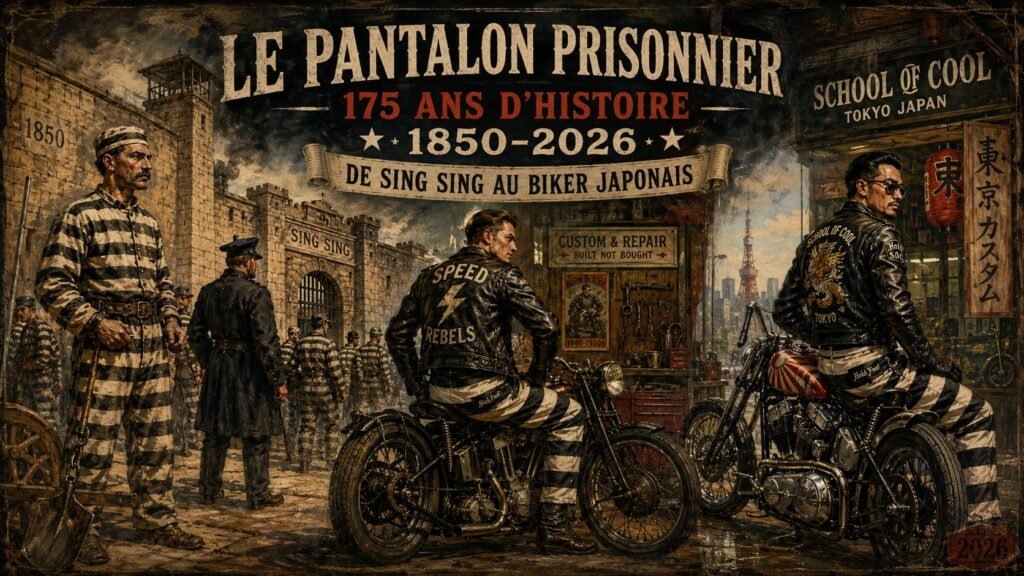
One hundred and seventy-five years, six countries, one obsession: black-and-white striped trousers have travelled through the centuries, from Sing Sing prison to the Japanese workshops that now turn them into a cult vintage biker piece.
Prisoner pants appeared in American prisons in 1850 as identification clothing. They entered pop culture in 1932 (the film I Am a Fugitive from a Chain Gang) and became a biker icon in Japan in the 1970s. Today, they are Hold Fast’s signature piece with more than 580 sales.
The precise origin of black-and-white striped trousers is New York State’s Auburn State Prison, in the 1820s–1830s. At the time, the American prison administration was seeking an immediately visible way to identify an escapee in a crowd. Contrasting vertical black-and-white stripes met four criteria:
- Visible from more than 100 metres in daylight
- Recognisable from the back and the front
- Impossible to disguise as civilian clothing
- Cheap to produce (denim dyed in bands)
By 1850, most American prisons had adopted the pattern. Sing Sing, Alcatraz and Folsom all dressed their inmates in stripes. The fabric was raw, robust 14–16oz denim, a construction that has barely changed since.
1932 – Entering pop culture
Prisoner pants first crossed the prison boundary through cinema. 1932 : Mervyn LeRoy directed I Am a Fugitive from a Chain Gang, starring Paul Muni. The film was nominated for three Oscars and caused a sensation. The striped trousers Muni wore for 90 minutes became an anti-establishment symbol.
Between 1932 and 1955, more than 80 American films and comics used striped trousers as a visual identifier. Bugs Bunny, Donald Duck, Tom & Jerry : they all wear convict trousers when the plot sends them to prison. It became a globally recognised trope.
“In American culture, striped trousers are no longer just a uniform: they are the emblem of rebellion against the system.”
1955 – Official decline, the birth of a legend
In the mid-1950s, American prisons abandoned stripes. Why? Because the pattern had become a mark of identity rather than shame. Inmates were proud to wear it. Prisons switched to plain raw denim or orange (Texas, Florida).
But it was too late: cinema had taken stripes around the world. In the 1960s–1970s, American and Japanese bikers adopted them as a counterculture uniform.
1970–1985 – Adopted by Japanese bikers
The modern history of prisoner pants unfolds in Japan. In the 1970s, the Bosozoku (Japanese motorcycle gangs) wanted a silhouette that visibly marked their belonging to a counterculture. Black-and-white stripes became their distinctive sign. This era also saw the birth of Japan Style biker culture, combining American workwear, Japanese tattoo traditions and film-noir aesthetics.
Japanese workshops (Studio D’artisan, Iron Heart, Pure Blue Japan) began making their own versions of prisoner pants. Raw 16–21oz selvedge fabric, a high-waisted carrot fit and short production runs.
2010 – The European revival with Hold Fast
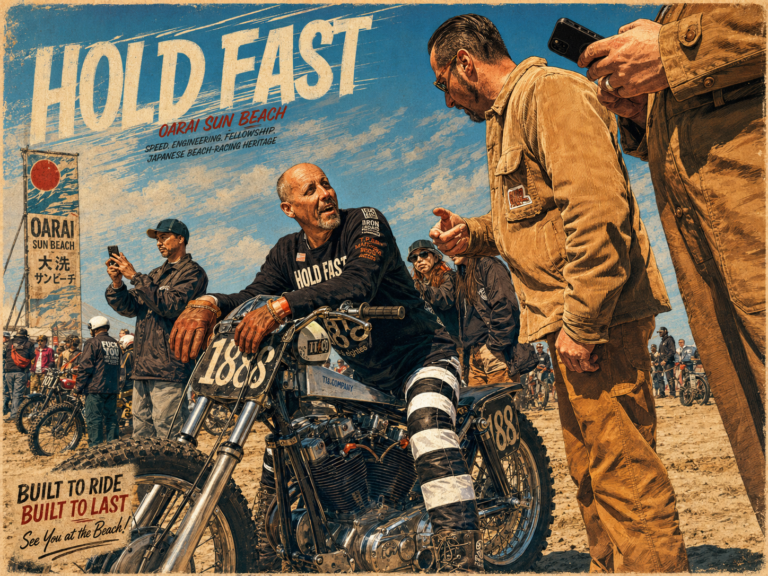
In 2010, the Hold Fast workshop in Marseille relaunched prisoner pants in Europe. The aim was to make the most authentic version possible, in Japanese 16oz denim, with a cut taken directly from the Auburn 1880 archives but adjusted for contemporary European body shapes.
The model became the brand’s signature piece. More than 580 units sold, with hundreds of bikers across France, Italy and Germany making them the centrepiece of their outfits. The 2026 collection of 16oz prisoner pants is now the absolute bestseller at School of Cool.
Today – The Hold Fast / Japan Style spirit
The current Hold Fast prisoner pants follow 4 rules:
- Fabric: Japanese 16oz denim woven on pre-1960 shuttle looms
- Fit: Straight workwear cut, mid-rise waist, slightly tapered carrot leg
- Stripes: Woven into the fabric, not painted, so they never fade away
- Construction: Triple-needle stitching, copper rivets and waist buttons for braces
Variants: leather versions and matching jackets also exist for a complete outfit. The Hollister leather jacket complements the trousers perfectly, creating an indigo, black and white contrast that recalls the original 1950s aesthetic.
How to wear prisoner pants today?
Three practical rules:
- Turn up the trouser cuffs once to reveal the embroidered Hold Fast logo on the right leg.
- Braces rather than a belt. Prisoner pants are designed with a high waist. The 1905 Pike Brothers leather braces are a fully coherent companion piece.
- Black engineer boots. No trainers. No dress shoes. The 1966 Explorer boots complete the silhouette.
For 9 more detailed outfits, see our complete lookbook (coming soon).
FAQ – Prisoner pants
Do prisoner pants shrink in the wash?
1–2 cm at the waist and 2–3 cm in length the first time (unsanforised raw denim). Wash cold and inside out the first time.
Are they available in leather?
Yes, in tanned lambskin. A great fit on the motorcycle for anyone seeking the premium option.
Hold Fast prisoner pants use US sizing (28, 30, 32, 34, 36, 38, 40, 42, 44). Measure your waist accurately: the denim stretches by 1–2 cm with wear.
The iconic striped trousers – available at School of Cool
175 years of history, 580+ sales, a living legend.