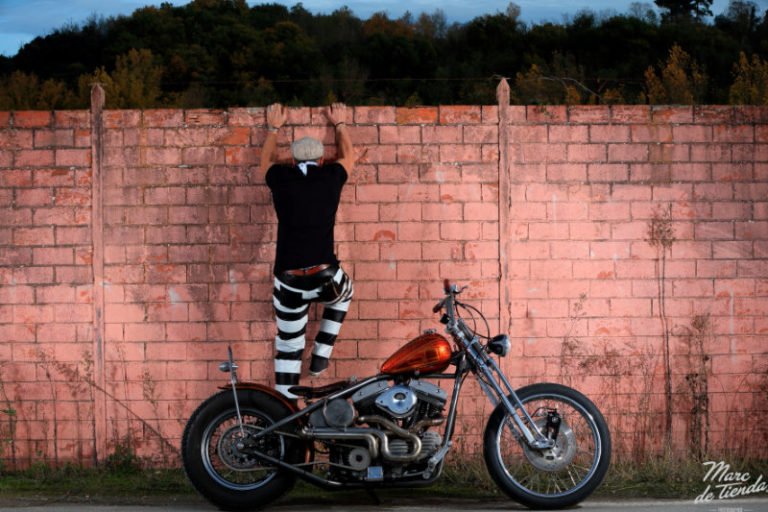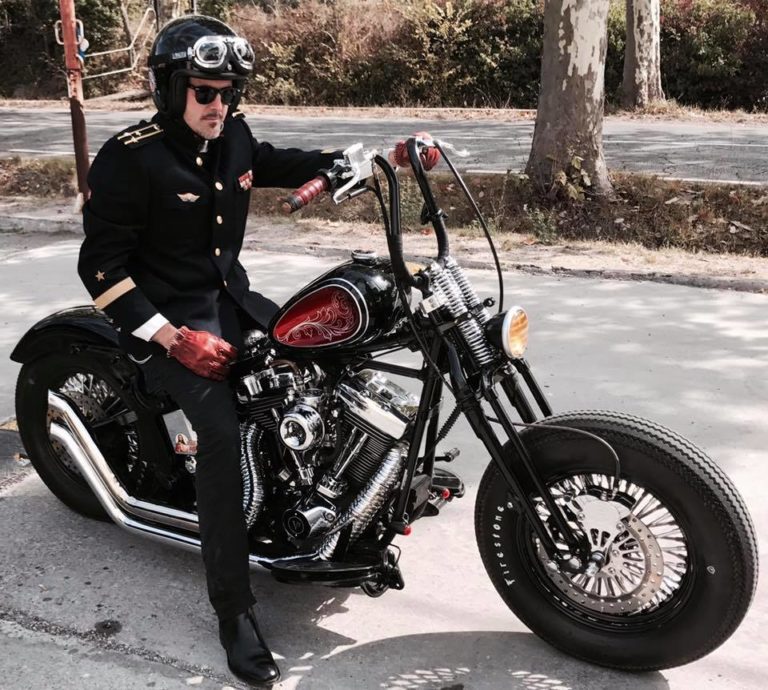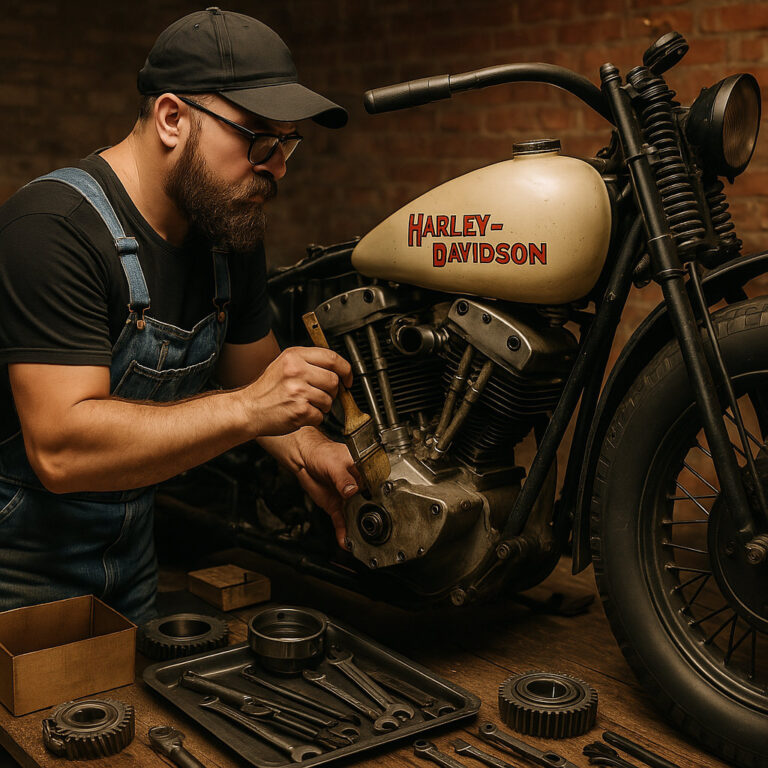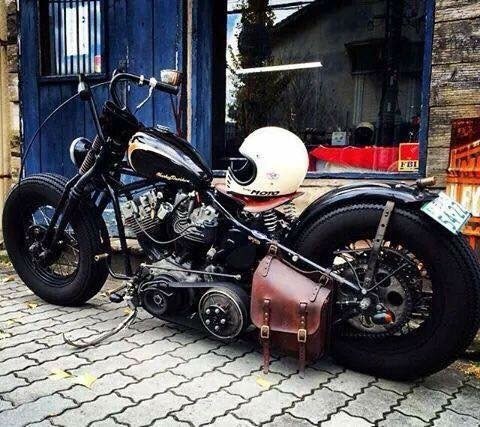
Harley-Davidson roadworthiness inspection 2026: complete guide for vintage and custom bikes, bobbers and choppers
In this article
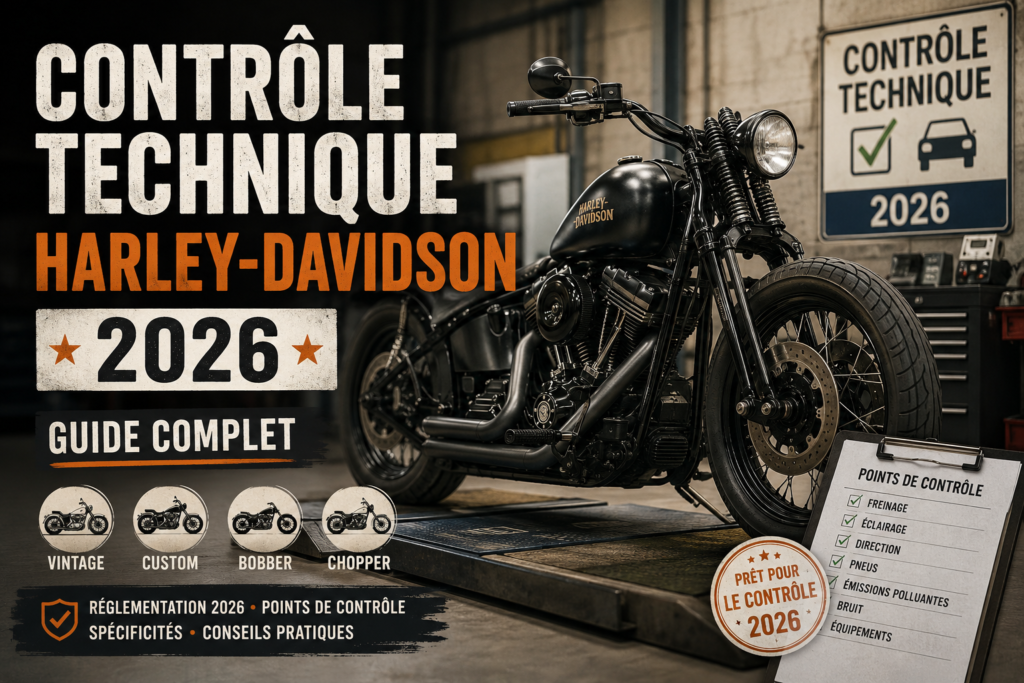
Since 15 April 2024, roadworthiness inspections have been mandatory for motorcycles in France. If you ride a Harley-Davidson—vintage, custom, bobber, chopper or café racer—this requirement often raises more questions than answers. This complete guide explains Harley-Davidson inspections in 2026, the checks, special cases and a checklist to help you pass first time.
Motorcycle inspections in France: what to know in 2026
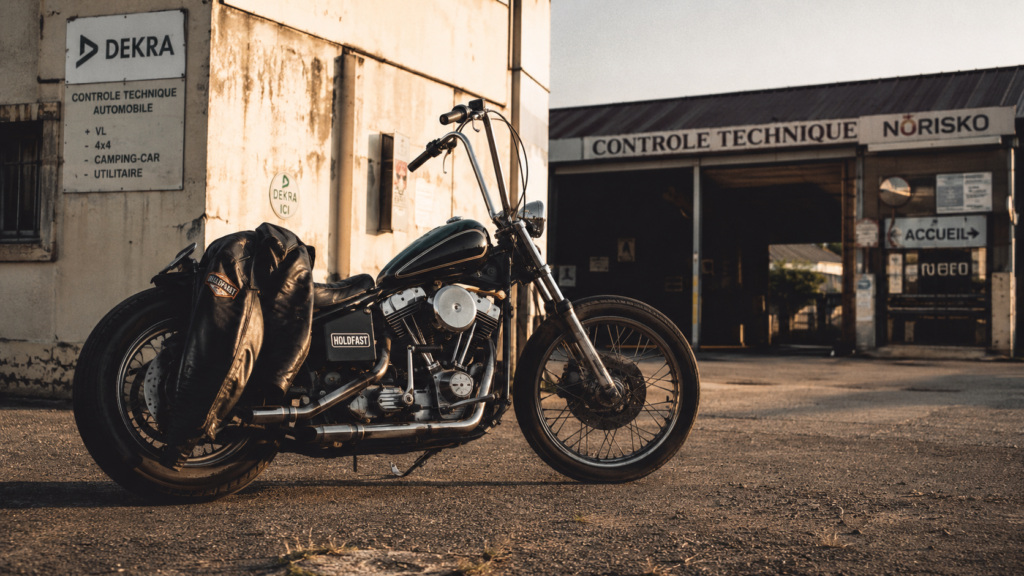
Motorcycle roadworthiness inspections were established by the decree of 9 August 2023 and came into effect on 15 April 2024. They cover motorcycles in categories L3e (two-wheelers), L4e (sidecars), L5e (three-wheelers) and L7e (heavy quadricycles). All Harley-Davidsons fall under L3e or L4e and are therefore covered, without exception.
Timetable by first registration date
The timetable has been phased in according to registration year:
- Registered before 2017 : first inspection required before 31 December 2024.
- Registered between 2017 and 2019 : first inspection before the end of 2025.
- Registered between 2020 and 2021 : first inspection before the end of 2026.
- Registered from 2022 onwards : first inspection five years after first registration, then every five years.
- General frequency : every five years after the first inspection, except private used-bike sales, which require an inspection less than six months old.
Many Harley riders believe that motorcycles built before 1960 are exempt. False : the regulations apply to all vehicles on the road, including older models such as Knuckleheads, Panheads, Shovelheads and Evolutions. A partial exemption does exist for historic vehicles, as discussed below.
The 78 inspection points on a Harley-Davidson
The inspection covers 78 points across nine main motorcycle functions. Some deserve particular attention on a Harley:
1. Vehicle identification
- Frame VIN visible and matching the registration document.
- Number plate of the required size: at least 210 × 130 mm on recent motorcycles. Watch out for cropped plates on bobbers.
- Manufacturer’s plate legible, often engraved on the right-hand fork tube on Harleys.
2. Braking
- Brake discs free from cracks, with limited distortion and adequate thickness.
- Brake pad thickness.
- Front and rear braking efficiency test.
- Hydraulic system maintains pressure, with no Brembo or Hayes Performance leaks.
- Brake fluid in good condition.
3. Lighting and signalling
- Headlamp: dipped beam, main beam and position light. Beam correctly adjusted.
- Rear light and brake light working.
- Four visible, approved indicators, with an E mark required.
- Number plate light fitted and working.
- Horn.
4. Wheels and suspension
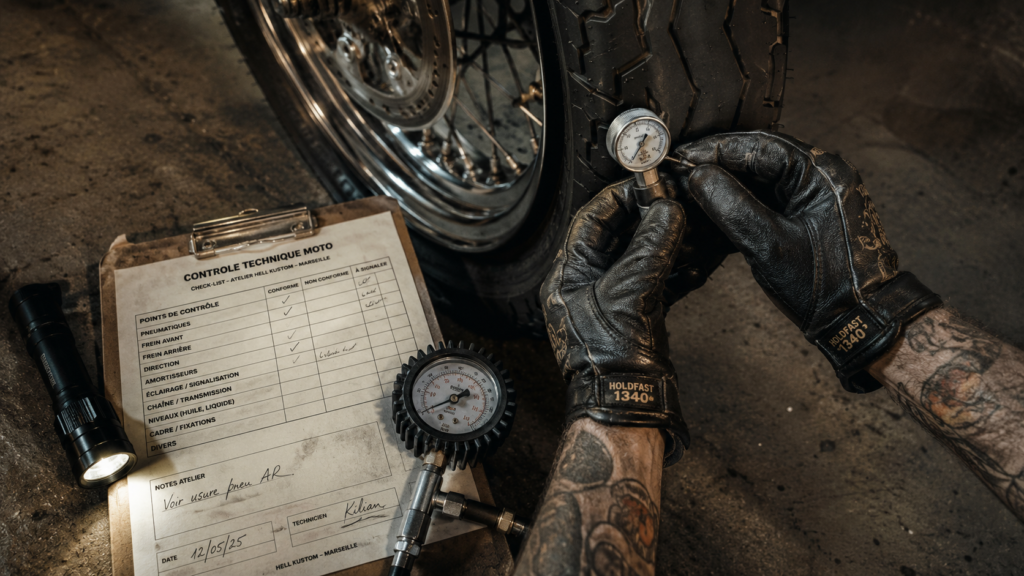
- Tyres: tread depth > 1 mm, no cracks and dimensions matching the registration document.
- No oil leaks from the front fork or rear shock absorber.
- Wheels running true, rims free from cracks.
- Steering moves freely, with no abnormal play in the steering head.
5. Emissions and noise
- Stationary noise measurement at 75% of maximum engine speed.
- No visible exhaust smoke indicating incomplete combustion.
- Compliant exhaust: the E mark must be visible, with no unapproved competition parts.
6. Bodywork and accessories
- Mirrors: at least one, with two compulsory on recent bikes, correctly fitted.
- Front and rear mudguards present and secured, a potential issue on radically shortened bobbers.
- Saddle securely fitted.
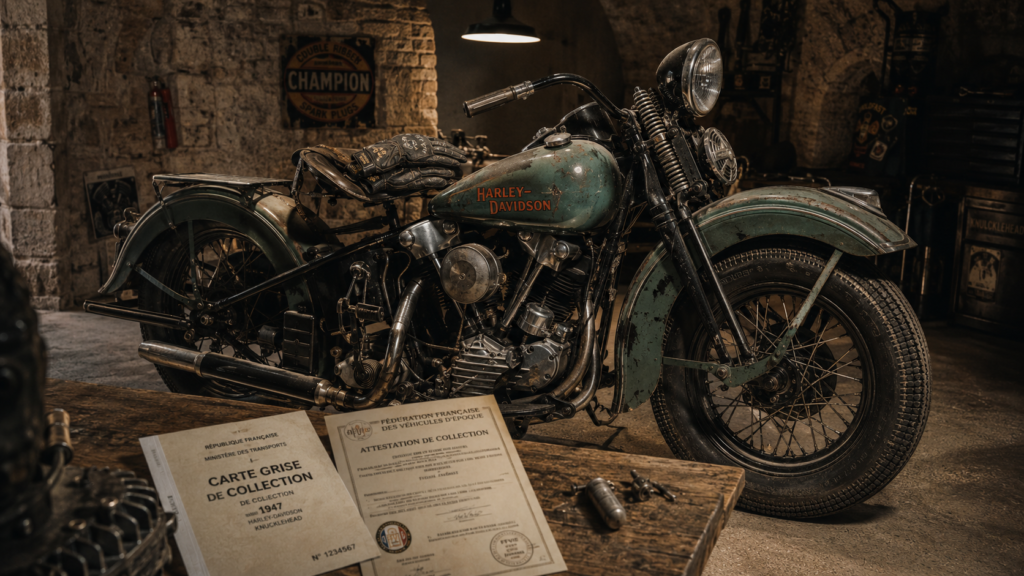
Special case: vintage Harley-Davidsons and historic vehicles
Harley-Davidsons built over 30 years ago—that is, vehicles built before 1996 in 2026—may qualify for historic vehicle status. This includes iconic models such as:
- Knucklehead (1936–1947) : automatically eligible.
- Panhead (1948–1965) : automatically eligible.
- Shovelhead (1966–1985) : automatically eligible. See our dedicated Shovelhead kick-start article.
- Evolution (1984–1999) : eligible if registered before 1996.
- The early Sportster Ironhead models are eligible.
How to obtain a historic vehicle registration
Three conditions must all be met:
- The vehicle is over 30 years old.
- Its type is no longer in production.
- The vehicle remains in its original condition: no major changes to the engine, frame or dimensions.
Apply on the ANTS website with a certificate from the FFVE, the French federation of historic vehicles. Approximate cost: €60 plus ANTS fees.
Benefits of historic status
- Roadworthiness inspection every five years with the same frequency but relaxed noise-emission checks.
- Period equipment may be used, with vintage indicators tolerated.
- Often cheaper insurance through specialist policies such as Hagerty or AMV Collection.
Warning : if your Harley has undergone major changes—an engine swap, an extended extreme-chopper frame or dimensions outside its registration specifications—it loses eligibility for historic status and must undergo individual vehicle approval, known as RTI, before inspection.
Custom Harleys—bobbers, choppers and café racers—and inspections
This is where things get more complicated. A custom Harley can pass inspection, but under strict conditions:
Modifications allowed without RTI
- Solo saddle in place of the original, including a custom leather saddle: see the Hold Fast Tuck’n Roll saddle).
- Handlebars such as ape hangers or drag bars, within the height limit of < 30 cm above the highest point of the saddle.
- Grips and approved custom mirrors, such asKustom Tech grips which are compliant.
- Auxiliary headlamp added, such as passing lights or bullet lights.
- Side bags in leather.
- Sissy bar and luggage racks.
Modifications requiring individual vehicle approval (RTI)
- Engine replacement with a different displacement.
- Frame modifications, such as an extreme-chopper extension or hardtail conversion on a Softail frame.
- Wheelbase changes exceeding 5% of the registration specifications.
- Significant bodywork changes affecting dimensions.
RTI is carried out by the DREAL and costs between €100 and €300, depending on the modifications. Without RTI, your Harley will fail at the initial identification check.
Custom exhausts: what passes inspection
The exhaust is the leading reason Harleys fail. Here is the key rule:
The mandatory E mark
Every exhaust used on the road must carry an E followed by a number such as E1 for Germany, E2 for France, E3 for Italy or E11 for the UK. This mark indicates approval under the applicable European standard.
Exhausts that fail inspection:
- Competition or racing-only exhausts without an E mark.
- Straight open pipes without baffles.
- Removable baffle adapters or dB killers.
- Homemade modifications such as drilling or shortening.
Noise measurement
The inspector performs a noise test at 75% of maximum engine speed. For a Harley, the threshold is 96 dB when stationary depending on its original approval, shown in field U2 of the registration document.
Practical tip: keep your custom exhaust’s certificate of conformity or technical sheet with the bike if available. It speeds up validation.
Indicators, lights and number plate: 2026 compliance
The custom motorcycle indicators have become the second leading reason for failure after exhausts. Many riders fit miniature bullet or edge-cut indicators without checking their approval.
Indicator approval requirements
- E mark visible and engraved on the housing, such as E1 or E11.
- Minimum illuminated area: 10 cm² per indicator.
- Minimum distance between the front indicators: 240 mm.
- Amber or orange colour; red and white are prohibited.
Good news: School of Cool custom motorcycle indicators are all E-approved, with visible marking. Our vintage LED headlamps also comply with ECE R113.
Number plate
- Format: at least 210 × 130 mm, or 145 × 210 mm since 2009.
- Reflective white background with black characters.
- Legible at 25 metres in normal conditions.
- A working number plate light is mandatory.
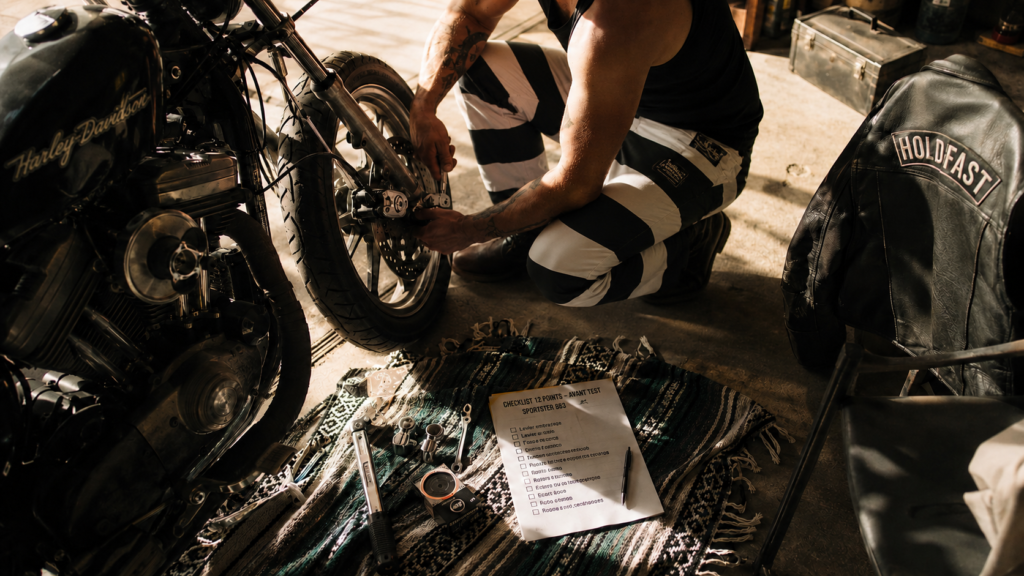
12-point checklist to prepare your Harley for inspection
Before booking an appointment, work through these checks:
- Identify prohibited parts : open pipes, unapproved indicators and a single mirror on a post-2017 motorcycle.
- Check the headlamp beam : a correctly adjusted dipped beam should not exceed 50 cm in height at a distance of 10 m.
- Test every light : headlamp, position light, brake light, indicators and number plate light. Replace blown bulbs.
- Measure tyre tread : it must exceed 1 mm; ideally over 2 mm for safety.
- Check tyre pressures according to the manufacturer’s manual.
- Inspect discs and pads : thickness must not fall below the manufacturer’s marked minimum.
- Inspect hoses : no leaks or cracks.
- Check the fork : no oil leaks from the tubes. Wipe them and ride; if they become wet again, there is a leak.
- Check the chain (Sportster) or belt (Big Twin) : correct tension and no stiff links.
- Bring the registration document and any modification certificates, such as RTI or exhaust conformity paperwork.
- Clean the motorcycle : a clean bike is easier to inspect and raises fewer unnecessary doubts.
- Allow 30 minutes between appointments in case a detail needs adjusting.
Retest: what to do after a failed inspection
If your Harley fails, the inspector issues a report detailing major (M) or critical (C) defects to fix.
- Minor defect : no action required; the inspection passes.
- Major defect : retest within two monthswith the motorcycle usable in the meantime.
- Critical defect : the motorcycle is immobilised except for the return journey; a retest within 24 hours is mandatory.
A retest costs approximately 20 € at the same centre. Arrange the identified repairs with your mechanic or carry them out yourself.
How much does a Harley inspection cost in 2026?
The average price is between €50 and €80 depending on the centre and region. Examples include:
- Norisko Auto / Securitest / Dekra: €55–70.
- Independent centres: €50–65.
- Large cities such as Paris, Lyon and Marseille are generally more expensive, by €10–15.
To find an approved motorcycle centre near you, the official UTAC OTC website lists certified establishments. Not every centre inspects motorcycles, so check before booking.
FAQ: Harley inspection questions
My Harley is 50 years old. Does it need an inspection?
Yes, unless you obtain historic vehicle registration. Even with that status, an inspection is required, with relaxed noise checks and fewer inspection points.
Can I ride before the first inspection?
Yes, within the regulatory deadlines. If you miss the deadline without completing the inspection, you risk a €135 fine and the vehicle being immobilised.
My Vance & Hines exhaust has no E mark. What should I do?
If you have the purchase invoice and manufacturer’s European approval certificate, show them. Otherwise, the inspector may require a retest. The article’s suggested approach is to refit the original exhaust for the inspection, then reinstall the V&H.
Which Harley exhausts are approved for 2026?
E-approved Vance & Hines, E-approved Bassani, S&S Cycle Slip-On models and E-approved Kesstech. Avoid unbranded AliExpress or eBay exhausts without visible markings.
My bobber has a 100 × 80 mm plate. Is it compliant?
No. The minimum plate size is 210 × 130 mm. A cropped plate will fail.
Can the inspector reject my Harley because of its appearance?
No. Appearance is not a criterion. Only the 78 predefined defects can justify rejection. If you suspect an aesthetic bias, ask for the factual defects identified.
What if my Harley is modified but has no RTI?
Either restore the motorcycle to its registered configuration for inspection—original saddle, exhausts and so on—or begin an RTI application with the DREAL. Allow 3–6 months and €100–300.
My custom Sportster has ape-hanger handlebars. Is that a problem?
Only if the grips are more than 30 cm above the highest point of the saddle. Measure before inspection.
How long does a motorcycle inspection take?
Between 30 and 45 minutes for a motorcycle in good condition. Allow an hour for a custom or vintage bike with special features to check.
Are inspections also mandatory for trikes and sidecars?
Yes. Trikes (L5e) and sidecars (L4e) are covered, just like solo motorcycles.
Recap: prepare your Harley in five minutes
Five things to remember from this article:
- Check the E mark on your indicators and exhaust: this is the leading reason for failure.
- If your Harley is over 30 years old, apply for historic vehicle registration through the FFVE.
- A custom Harley needs RTI approval for major frame, engine or dimension changes.
- Tyres with > 1 mm tread, working brakes and a leak-free fork.
- A number plate at least 210 × 130 mm, with a working light.
For more information, read our related articles: How to tell whether a Harley is Stage 1 and How to restore a vintage Harley.
For approved, ready-to-fit parts such as indicators, LED headlamps and Kustom Tech grips, explore our custom motorcycle accessories category. All our products carry visible European approval marks.
Article updated on 12 May 2026. Regulations change, so always check the official information on service-public.fr before your inspection.