2026 Harley-Davidson Deadwood: price, engine and availability
In this article
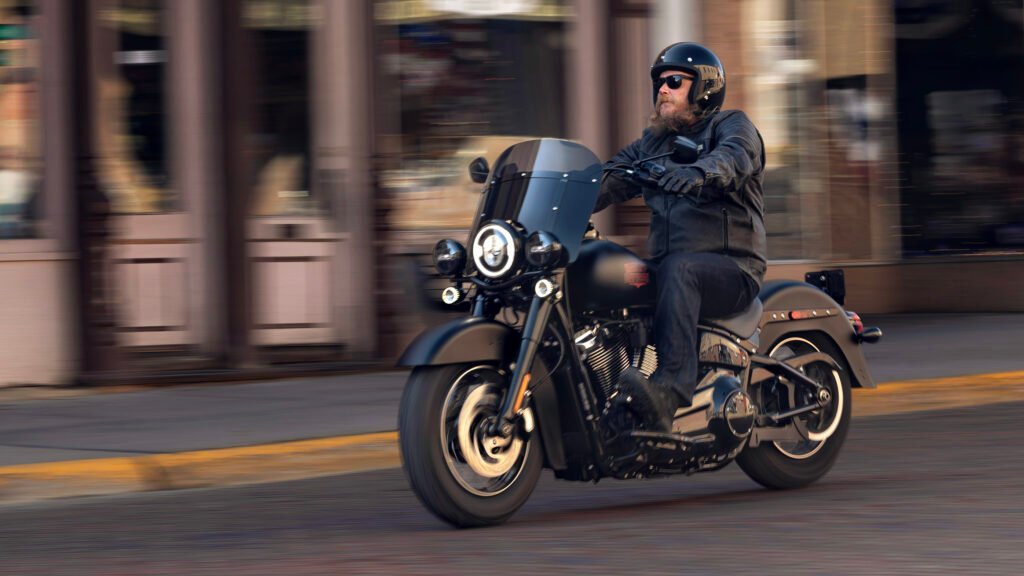
The 2026 Harley-Davidson Deadwood puts the bobber back in the spotlight: a low silhouette, a great deal of black and a large air- and oil-cooled V-Twin. Unveiled in the United States, this cruiser does more than recreate an old postcard. Beneath its post-war-inspired lines are a Softail chassis and contemporary electronic rider aids.
Its name comes from a town in South Dakota’s Black Hills, close to Sturgis. The idea behind the motorcycle is simple: capture the stripped-back character of a custom bike without abandoning the equipment expected of a modern Harley. At launch, however, it was not part of the European range. So what does it offer, how much does it cost and who is it for?
This guide draws on the manufacturer’s information and specialist motorcycle publications. It is not a road test: the riding considerations below are points to check in person. Specifications relate to the 2026 US model and may vary by market and model year.
Harley-Davidson Deadwood: the essentials
The Deadwood belongs to Harley-Davidson’s cruiser family. It combines the Milwaukee-Eight 117 Classic engine with a Softail frame and discreet rear suspension. A solo seat, wire-spoke wheels and a smoked screen give it an immediately recognisable profile.
- Model: 2026 Harley-Davidson Deadwood.
- Engine: 1,923 cc Milwaukee-Eight 117 Classic V-Twin.
- Claimed power: 98 US hp, or 73 kW, at 4,600 rpm.
- Claimed torque: 120 lb-ft, approximately 163 Nm, at 2,500 rpm.
- Transmission: six speeds and final belt drive.
- Running-order weight: 686 lb, approximately 311 kg.
- Fuel tank: five US gallons, approximately 18.9 litres.
- US launch price: from $17,999, before possible additional charges.
- Launch markets: the United States and Canada.
These figures describe the American motorcycle, not a hypothetical European specification. US horsepower and metric horsepower are different units. Equally, converting the US price directly into euros would not give the retail price of a motorcycle approved and sold in France.
Why the Deadwood name matters
Deadwood is a small town in the Black Hills of South Dakota. Its history brings to mind the gold rush and stories of the American West. For motorcyclists, it also sits close to Sturgis, home to one of the best-known gatherings in American motorcycle culture.
Harley-Davidson connects the new model with post-war motorcycle gatherings. Its launch release recalls that participants in the 1947 Black Hills Motor Classic rode through the region and its towns. The name therefore connects the motorcycle with roads, a rally and a particular idea of motorcycle travel.
The Deadwood’s public debut was announced for 7 August 2026 during the Sturgis Motorcycle Rally. This setting matters: Harley placed its new cruiser in an environment familiar to many of its enthusiasts, rather than presenting only a specification sheet.
It is also worth keeping the distinction clear. The historical connection forms part of the manufacturer’s story; the Deadwood itself is a modern production motorcycle. The interesting question is how that inspiration translates into design and equipment.
Bobber style: inspiration from motorcycle customisation
A bobber suggests a motorcycle stripped of anything its owner considered unnecessary. After the Second World War, American riders modified their bikes to reduce weight, change their appearance and suit their own needs. Shortened mudguards and removed accessories helped establish the visual language.
The Deadwood borrows several of those cues: a solo seat, a low stance, dark surfaces and little ornamentation. Yet it keeps a generous tank, a screen, electronic equipment and the features expected of a new motorcycle. It is a modern interpretation of a bobber, not a faithful restoration of a vintage machine.
That distinction matters when choosing a bike. A handmade bobber may be unique, but its comfort, reliability and road legality depend on the build. A production cruiser offers a known platform, a dealer network and factory-defined equipment. In return, some of the compromises are chosen at the factory.
Here, “stripped back” primarily describes the look. LED lighting, electronic management and rider aids remain. On a modern motorcycle, a minimalist appearance does not mean the engineering has disappeared; much of it is simply less visible.
A black Harley with plenty of detail
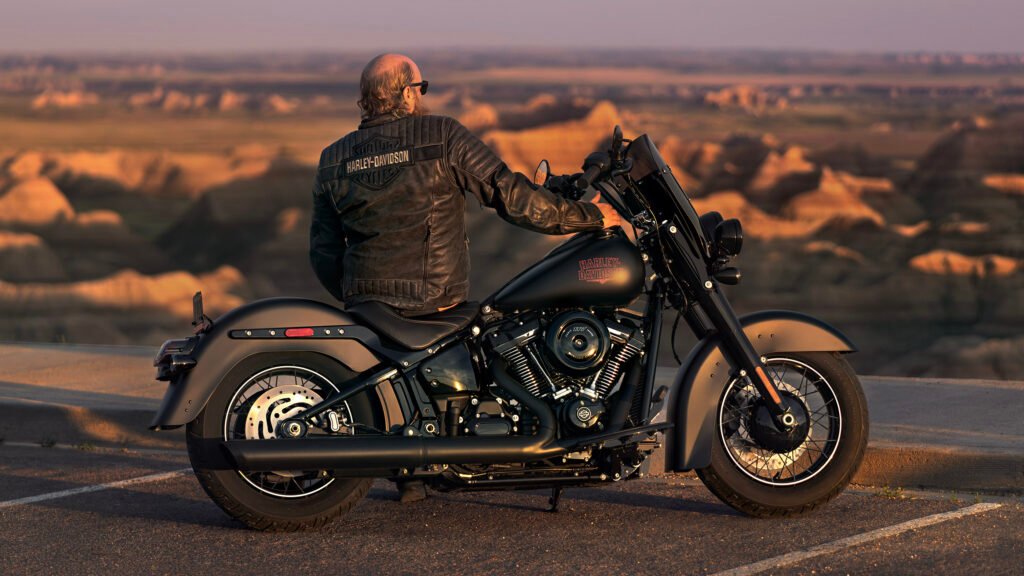
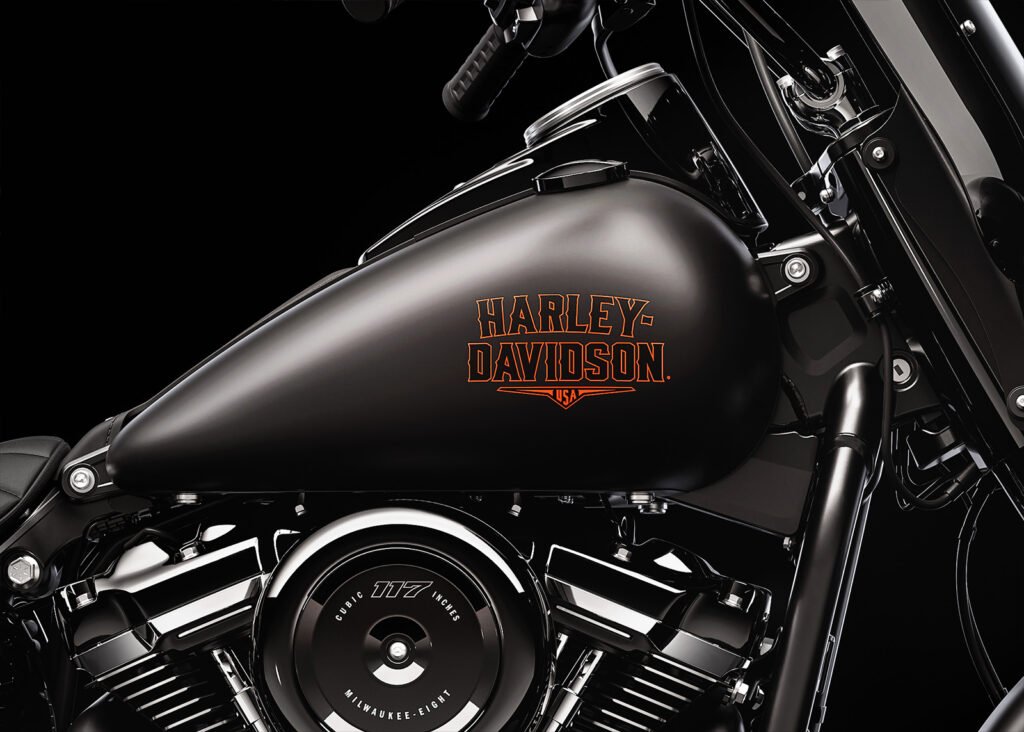
The first thing you notice is the Denim Black finish. The tank, mudguards, engine components and other parts contribute to a dark overall silhouette. Orange tank graphics provide contrast and prevent the motorcycle from becoming a single black shape.
The teardrop tank recalls the brand’s larger cruisers. Its volume gives the motorcycle presence and contrasts with the short seat. A central console continues that traditional theme while combining classic instruments with digital information.
Up front, the smoked screen changes the profile and may deflect some wind. Its effectiveness depends on the rider’s height, position and conditions. Without riding the motorcycle, it would be unwise to promise the protection of a full touring bike.
The solo seat emphasises the model’s individual character and exposes the rear visually. Anyone intending to carry a passenger should check available accessories, their compatibility and local legal requirements. A passenger seat is not just a cushion: footrests and vehicle approval matter too.
Wire-spoke wheels and tyres
The tubeless wire-spoke wheels add to the classic look, combining dark rims and bright spokes. The US specification lists 16-inch tyres at both ends: 130/90B16 front and 150/80B16 rear. Some articles quote different sizes; for the American 2026 model, we follow Harley-Davidson’s own specification.
Here, tubeless describes the wheel configuration listed by the manufacturer. When replacing tyres, follow the dimensions, load and speed ratings and recommendations for the individual motorcycle. A similar size is not automatically an approved fitment.
Milwaukee-Eight 117 Classic: the heart of the Deadwood
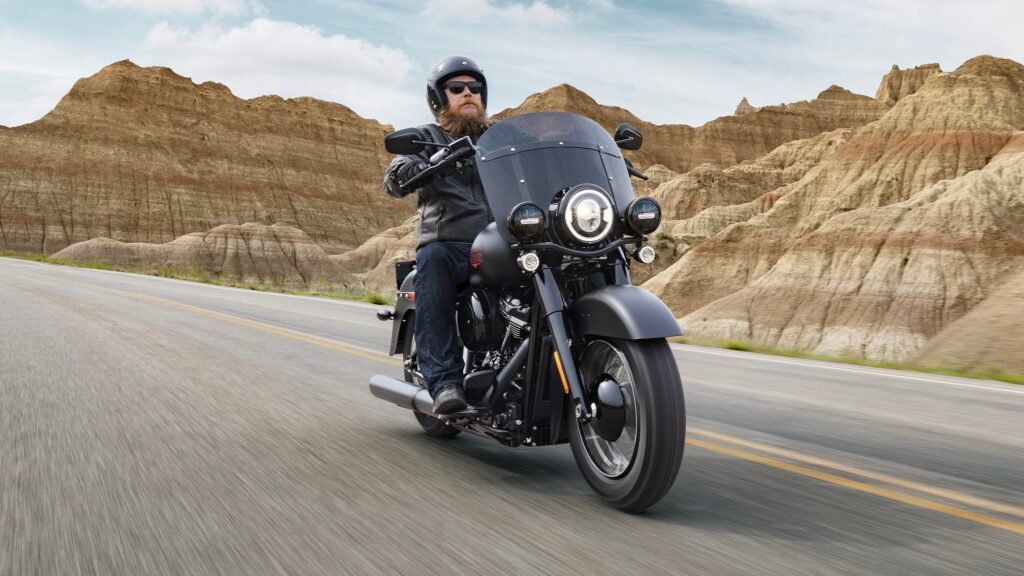
The Harley-Davidson Deadwood uses the 1,923 cc Milwaukee-Eight 117 Classic V-Twin. Electronic fuel injection and a six-speed gearbox accompany an air- and oil-cooled engine whose proportions retain the visual character of a large American V-Twin.
The US specification claims 98 hp and 120 lb-ft of torque, with peak torque at 2,500 rpm. In practical terms, that points to a motor designed to deliver substantial pull without needing its highest engine speeds. The appropriate gear, load and road conditions remain important.
Torque alone cannot describe how a motorcycle feels. Throttle response, gearing, luggage, gradient and road surface all influence the experience. Without a Deadwood road test, it is better to explain its intended character and published figures than promise a particular sensation.
Peak power is quoted at 4,600 rpm. That does not turn the Deadwood into a sports bike: its geometry, riding position and styling place it firmly in the cruiser world. Specifications are most useful when comparing similar machines and checking that measurement methods and markets match.
Final belt drive is a familiar Harley-Davidson choice. Owners still need to follow the manual’s inspection and maintenance requirements. Belt condition, tension and riding environment deserve the attention specified by the manufacturer.
What does 117 mean?
The number refers to displacement in cubic inches, a unit familiar to American motorcycle enthusiasts. Converted to metric units, it is approximately 1,923 cc. That figure identifies a large engine; it does not automatically tell you the insurance cost or how easy the motorcycle will be to move at walking pace.
When comparing Harleys, check the exact engine version, model year and market-specific figures. Similar names can conceal different settings or equipment. A test ride is more useful than a numbers contest if riding position, braking or low-speed confidence is your priority.
The Softail platform, explained
A Softail frame aims to keep the clean appearance of a traditional rear triangle while incorporating rear suspension. On the Deadwood, the monoshock is hidden beneath the motorcycle’s line. It contributes to suspension travel and wheel control without the visual presence of two large side-mounted shocks.
The telescopic front fork is 49 mm in diameter. At the rear, Harley describes a preload-adjustable monoshock. Adjustment can help accommodate load within the specified range, but it cannot turn limited suspension travel into the travel of an adventure bike.
The low stance is a major part of the Deadwood’s appeal. It also means paying attention to ground clearance and available lean angle. Harley quotes 27 degrees on both sides for the US model. A catalogue figure is no substitute for caution around roundabouts, steep entrances or bumpy bends.
On uneven roads, the feel depends on settings, tyres and the surface. If a test ride is available, try a familiar route with speed bumps, repaired tarmac and low-speed manoeuvres. These reveal practical details a photograph cannot show.
Seat height and weight: read both figures together
Harley-Davidson lists a laden seat height of 25.5 inches, approximately 648 mm, and an unladen height of 26.5 inches, approximately 673 mm. Both figures are meaningful in their own context. Specifications that omit whether the motorcycle is laden can appear to disagree without actually doing so.
A low seat may help you put your feet down, but seat width and leg length matter too. Try the bike in your usual boots. Check that you can steady it, reach the side stand and keep your arms relaxed with the handlebar turned.
Running-order weight is approximately 311 kg. Once moving, weight distribution and geometry affect how heavy a motorcycle feels. At a standstill, a slope or uneven surface can make manoeuvres demanding. A low seat does not make a motorcycle lightweight.
New riders should take time to practise slow-speed manoeuvres and compare motorcycles. Experience, physique and confidence are more useful guides than a universal rule. A supervised dealer test ride can help establish what suits you.
Rider aids on the Harley-Davidson Deadwood
The retro silhouette does not mean the electronics are old-fashioned. Harley describes ABS, traction control, tyre-pressure monitoring and functions that account for lean angle. The display gives the rider information including the selected mode and system status.
ABS is designed to limit wheel lock under braking. The cornering-enhanced version takes lean angle into account within the system’s operating limits. It does not suspend physics: excessive speed, unsuitable tyres or a very slippery surface can still cause a loss of grip.
Traction control helps limit excessive rear-wheel spin under acceleration. Its intervention depends on conditions and settings. In the wet, anticipation, smooth inputs and a safe following distance remain essential.
Drag-torque slip control addresses certain deceleration situations, such as an abrupt throttle closure or downshift. It aims to reduce excessive rear-wheel slip associated with engine braking. These systems assist the rider; they do not replace sound technique or properly maintained tyres.
Road, Sport and Rain: which mode?
The model is presented with Road, Sport and Rain modes, offering settings for different conditions. Consult the manual for the exact parameters of the relevant model year and market. A mode name is not a guarantee of grip.
Road is a natural starting point for normal everyday conditions. Sport is intended for riders seeking a more responsive setting, subject to the manufacturer’s actual calibration. Rain is intended for reduced grip; it cannot make a soaked road behave like dry tarmac.
Explore modes gradually in familiar surroundings. Where possible, make settings before setting off and keep your attention on traffic. Do not attempt to test the limits of an assistance system on public roads.
Tyre pressure and instruments
The tyre-pressure monitoring system can warn of low or high pressure. This is useful when temperatures change, but it does not replace regular checks with a reliable gauge or visual inspection of the tyres.
The five-inch instrument combines an analogue speedometer with digital information. The US specification includes gear indication, fuel level, riding modes, estimated range and warning lights. Availability of individual features can depend on configuration.
LED lighting and a USB-C socket bring everyday convenience to a motorcycle inspired by the post-war years. They express the Deadwood’s wider approach: traditional visual cues paired with modern functions.
Braking: what the specifications reveal
The US specification lists a fixed four-piston front caliper and a floating two-piston rear caliper, with one disc at each end. Braking feel depends on tyres, surface, load, temperature and control inputs as well as the hardware.
On a heavy motorcycle, leave room and anticipate. ABS does not necessarily shorten stopping distances in every situation. It helps manage wheel lock, but it cannot create grip where the road offers none.
During a test ride, assess whether the lever shape, pedal position and control feel suit you. Afterwards, have the braking system inspected in line with the maintenance schedule and the advice of the professional responsible for the bike.
Fuel tank, consumption and range
The tank holds five US gallons, approximately 18.9 litres. Harley-Davidson quotes an estimated 47 miles per US gallon, roughly 5 litres per 100 km. This is a reference estimate, not a promise for every journey.
Speed, wind, stops, luggage and riding style affect consumption. Available reserve and usable range also depend on the gauge and circumstances. On long trips, plan a margin rather than relying on every last drop.
As a purely mathematical example, dividing 18.9 litres by 5 litres per 100 km gives about 378 km. This is not a guaranteed range. It assumes all capacity is usable and consumption stays constant, neither of which should be assumed when planning a real ride.
To estimate your own consumption, fill the tank, reset a trip meter and note the litres added at the next fill. Divide litres by kilometres and multiply by 100. Repeat over several tanks to account for different journeys.
How much does the Harley-Davidson Deadwood cost?
At its July 2026 announcement, Harley-Davidson quoted a US starting price of $17,999. The American listing adds a plus sign. The final amount can vary with fees, taxes, options and dealer conditions.
Converting that number into euros at the exchange rate would be misleading. A French launch would involve a local offering, applicable taxes, distribution costs and suitable approval. An official French price cannot be inferred from the US figure.
Canada was also included in the launch announcement. Its price and conditions should be checked with Harley-Davidson Canada or a local dealer. The US figure does not automatically apply there.
If you find an advertisement in euros, ask exactly what it includes: an already registered motorcycle or one still requiring import, warranty, paperwork, charges and possible modifications. An attractive headline can look very different once all costs are included.
Will the Deadwood be available in Europe?
At launch, Harley identified the United States and Canada as the markets for the 2026 motorcycle. Sources consulted for this guide did not confirm a European launch. We cannot therefore state a European release date or euro price as established fact.
A lack of announcement does not prove that a future launch is impossible. It simply means there was no official confirmation available to support such a promise. Ranges change by year and market, so check your local Harley-Davidson catalogue and dealer for current information.
Watch for three separate developments: inclusion in the local range, publication of market-specific technical details and the opening of orders. A social-media image or a US webpage visible from Europe does not demonstrate that the motorcycle is approved and on sale locally.
Importing a US Deadwood: questions before signing
Importing may seem tempting when a model is absent from the local catalogue. Before committing, ask qualified professionals for a written estimate of procedures and costs. Customs, tax and technical rules vary with circumstances and can change.
Check the vehicle identification, original paperwork, entry conditions and registration procedure. Lighting, noise, emissions and other characteristics may need inspection or modification. A motorcycle legally sold in the US is not automatically eligible for registration in every European country.
Ask an insurer before purchase; it may require specific documentation and specifications. Also check parts, servicing and warranty. A warranty offered in one market does not necessarily apply in the same way elsewhere.
These are general considerations rather than personalised legal or administrative advice. The relevant authorities and an import specialist can confirm the process for the particular motorcycle. Until the answers are in writing, treat the purchase as a project under investigation.
Deadwood versus Heritage Classic
Specialist publications compare the Deadwood with the Heritage Classic because of their Softail underpinnings and 117 Classic engine. That family connection does not mean they target exactly the same use. Styling and equipment point them towards different priorities.
The Deadwood favours a dark appearance, solo seat and a profile without factory saddlebags. The Heritage Classic places greater emphasis on travel and a classic presentation. Check each model year and country, however, as equipment can change.
A rider who usually travels alone and prefers a visually simple motorcycle may be drawn to the Deadwood. Someone who regularly carries luggage or a passenger may avoid additional purchases and modifications by starting with a more fully equipped configuration.
The comparison extends beyond styling. Price, local availability, wind protection, luggage options and maintenance all matter. The better choice is the one that suits actual journeys, not only the more appealing photograph.
Deadwood versus Street Bob
The Street Bob name also suggests a stripped-back Harley. Comparing models properly means checking exact versions rather than relying on labels. Engines, wheels, riding positions and equipment may vary by year and market.
The Deadwood combines its dark finish with broad mudguards, a screen and 16-inch wheels on the US specification. Visually, it resembles a large classic cruiser given a darker treatment. The Street Bob follows its own recipe, with different proportions and presentation.
At a dealer, start with the points of contact: seat, handlebar, controls and legroom. Then assess rider aids, luggage capacity and the price of necessary accessories. Finally, compare prices in the same market for motorcycles that are actually available.
A US Deadwood and a locally sold Street Bob may not be directly comparable purchases, since the former was not announced for Europe at launch. The exercise still helps clarify priorities: dark styling, seat height, engine, equipment and daily use.
Deadwood versus Low Rider S
The Low Rider S and Deadwood both belong to Harley-Davidson’s cruiser world, but their styling points to different intentions. The Deadwood highlights blacked-out bobber cues and the Black Hills; the Low Rider S has a more performance-oriented identity in the range.
Compare models available at the time of purchase. Look at specifications for the same year and market, then examine dimensions, engine, brakes and equipment. More power on paper does not establish which bike will suit your daily life.
Posture matters. Depending on your build, a seat, handlebar or controls can feel natural or tiring. For longer trips, consider wind protection, support points and luggage options.
Ask for a complete quote. A motorcycle that meets your needs as delivered may cost less to equip than one needing a different seat, bars and storage. The advertised price is only the start of the comparison.
Daily riding: questions to ask yourself
The Deadwood attracts attention, but motorcycles also spend time in traffic, car parks and garages. Before imagining a Black Hills highway, consider an ordinary week. Where will you park? How far will you ride? Must you carry a lock, rain gear or a computer?
Handlebar width, overall dimensions and running-order weight all affect manoeuvres. With the seller’s agreement, try taking the bike out of a parking space, standing it upright and moving it with the engine off. Begin on level ground before considering a slope.
A low seat can be reassuring, but foot placement is only one part of control. Hands should reach the controls comfortably, knees should remain relaxed and the rider should have a clear view. A dramatic stance is not always comfortable after an hour in traffic.
Heat, vibration and ease of filtering cannot be reliably inferred from a specification sheet. Conditions and body shape matter. Since we have not road-tested the Deadwood, these remain things to assess in person rather than ready-made conclusions.
Parking and setting off safely
When possible, choose firm ground with enough room to leave without pushing the motorcycle backwards uphill. Check the side-stand position and avoid soft or very hot surfaces. A small side-stand plate may help on uncertain ground.
At a stop, account for the road’s slope and keep the bike balanced. Wear suitable footwear and watch for loose gravel. With a motorcycle weighing over 300 kg, the best manoeuvre is often the one you planned well enough to avoid.
In traffic, rider aids cannot see opening doors, pedestrian crossings or turning vehicles for you. Observation, anticipation and a margin of space remain your first tools.
Can you tour on the Deadwood?
An approximately 18.9-litre tank and a screen invite thoughts of longer journeys. The solo seat and lack of factory saddlebags nevertheless underline the stripped-back design. Touring depends on preparation and compatible accessories.
Start by listing what you want to carry. A day out may require documents, payment, water and rain gear. A weekend adds clothing and toiletries, perhaps camping equipment. The right luggage follows from that list rather than appearance alone.
Before fitting a bag, check mounting points and clearance from exhausts, wheels and moving parts. Loads must not obstruct lights, controls or suspension travel. Respect the motorcycle’s payload limit and both manufacturers’ instructions.
A stationary check is not enough. After a short distance, stop somewhere safe and inspect the fastenings. Repeat during the trip. A loose strap or moving bag can become dangerous before it becomes uncomfortable.
Plan regular breaks and match daily distances to your experience. Seat shape, wind and weather affect fatigue. No universal figure can promise that every rider will cover a particular distance comfortably.
Choosing a saddlebag that suits the lines
A black, low motorcycle leaves little visual room for bulky accessories. A small leather bag may complement the look; a larger one may better serve regular journeys. The right compromise depends on contents and mounting points.
Measure before ordering. Check width, height, suspension travel and exhaust proximity. Do not assume compatibility simply because another Softail looks similar: supports and accessories must be confirmed for the Deadwood and its model year.
Check water resistance too. A leather saddlebag is not necessarily waterproof. A cover or waterproof inner pouch helps protect sensitive belongings in rain.
Customising the Deadwood while keeping its character
Bobber culture encourages owners to make a motorcycle their own. On a new bike, however, personal taste must be balanced against technical requirements. An attractive part should fit correctly, be installed properly and be permitted for its intended use.
The seat is often the first item considered. A different shape may change support or reach to the ground. Before buying, check mountings, foam thickness and the position it creates. A lower seat is not automatically more comfortable and may bring your legs closer to the tank.
Handlebars also change posture. Width, height and pullback affect shoulders, wrists and manoeuvring. Major changes can require different cables, hoses or adjustments. Use a competent installer and check the full steering range.
Mirrors, grips and trim offer subtler changes. They must preserve visibility and the operation of controls. Do not sacrifice instrument visibility or brake access for a cleaner photograph.
Exhausts: style, sound and compliance
V-Twin sound is part of a Harley’s appeal. Changing an exhaust can have consequences for noise, emissions, insurance and warranty. Rules vary by country and use. Check before ordering and keep documentation for fitted parts.
A label such as “racing”, “competition” or “off-road use” does not mean equipment is legal on public roads. A reference or certificate must also match the motorcycle, installation and relevant jurisdiction.
Installation may require diagnostics or engine-management work. Consult a qualified professional. An unsuitable modification can cause running problems without delivering the result you expected.
Passenger accessories: do not improvise
The Deadwood is presented with a solo seat. If you want to carry a passenger, ask which solutions are available for the exact motorcycle and country. A suitable configuration includes a seat, foot support and any equipment required by local law.
Check maximum load and the effect on suspension settings. Passenger, clothing and luggage weight all add to the rider’s weight. Calculating this before departure is better than discovering the motorcycle is overloaded later.
Maintenance and ownership costs
Purchase price is only part of the budget. Consider insurance, fuel, scheduled maintenance, tyres, brakes and personal equipment. Parking, security devices, accessories and transport can add further costs.
Request the maintenance schedule for the relevant model and market. Intervals and operations depend on the manual and use. Keep invoices and consumable references: a clear history helps you maintain the motorcycle and document its condition for resale.
Regularly inspect tyres, controls, levels, lights and possible leaks. A quick pre-ride check does not replace a service, but it may reveal trouble early. If a warning light or unusual behaviour concerns you, consult the manual and a professional.
Wire-spoke wheels also need attention in line with the manufacturer’s guidance. Do not assume tubeless wheels are inspected exactly like solid wheels. Consult a specialist if you notice damage, pressure loss or anything unusual.
Caring for the Denim Black finish
Matt or satin paint may need different care from gloss paint. Before using a product, consult Harley-Davidson’s recommendations for the exact finish. Some polishes intended for gloss finishes can alter the desired appearance.
Work on a cool, clean surface with suitable products and clean cloths. Avoid rubbing one small area aggressively. Test unlisted products on an inconspicuous spot and follow their instructions. Dark finishes can make dust and marks noticeable; regular gentle care matters more than force.
After salty or muddy roads, appropriate cleaning helps remove deposits. Dry the motorcycle according to the guidance and inspect hard-to-see areas. Avoid directing a powerful jet at sensitive components, bearings or connections.
Who is the Harley-Davidson Deadwood for?
The Deadwood will first appeal to riders who enjoy American cruisers, V-Twins and blacked-out styling. Its solo seat and lack of factory luggage suggest a focus on the individual rider. The tank and screen leave room for longer trips if those configuration compromises suit you.
It may also appeal to custom enthusiasts who want to start with a new motorcycle. The modern platform offers a defined maintenance framework and equipment. Each modification still needs to suit the exact version and local rules.
It is less obviously suited to someone seeking a lightweight bike to move, two ready-to-use seats or integrated luggage from the outset. Adaptations may be possible, but availability and cost should be checked before deciding.
For a European buyer, the first question is availability. A comparison with a locally sold bike must include access to the vehicle, possible formalities, dealer support and maintenance. A desirable motorcycle on a screen is not necessarily the easiest one to own locally.
Our view: strong identity, clear limitations
The Deadwood succeeds at communicating an identity through a few visible elements. Black finish, solo seat, tank, wire wheels and name form a coherent whole. Harley does not hide the motorcycle’s modern nature; it incorporates it into a classically inspired package.
A large engine, Softail platform and current rider aids complete the proposal. Those specifications suggest a torque-focused road cruiser. They do not, by themselves, establish comfort, handling or wind protection.
For European readers, the main obstacle is commercial: the launch announcement targeted the US and Canada. An import project therefore deserves careful investigation. Until a local announcement appears, the American price is a reference point, not a promise.
The appeal lies in the combination of older influences and modern equipment. The reason to try one, if the chance arises, is to find out whether that combination suits your body, roads and riding habits.
Harley-Davidson Deadwood FAQ
Is the Harley-Davidson Deadwood a 2026 model?
Yes. Harley-Davidson announced the Deadwood in July 2026 as a 2026 model, with a public debut planned at Sturgis in August. Some articles used another year in their headlines; this guide follows the manufacturer’s designation for the motorcycle presented.
What engine does the Deadwood use?
It has the 1,923 cc Milwaukee-Eight 117 Classic V-Twin. US figures are 98 hp, or 73 kW, and approximately 163 Nm of torque. These apply to the American version and the manufacturer’s stated measurement method.
How much is the Harley-Davidson Deadwood?
The announced US starting price was $17,999, before possible additional charges. It is not a European price. Taxes, transport, approval and local conditions prevent a direct conversion into a retail figure.
Can you buy a Deadwood in Europe?
The launch announcement named the US and Canada. No official European date was confirmed in the sources consulted for this guide. Check the current range with your local Harley-Davidson representative before arranging a purchase.
How much does it weigh?
Harley-Davidson quotes 686 pounds in running order, approximately 311 kg. Consider this alongside seat height and width, especially for low-speed manoeuvres and parking.
What is the seat height?
The manufacturer lists approximately 648 mm laden and 673 mm unladen. The distinction matters when comparing specifications. Your reach to the ground also depends on inseam, boots and seat width.
Does it have electronic rider aids?
Yes. Harley lists ABS, traction control, drag-torque slip control and tyre-pressure monitoring, including functions that consider lean angle. Consult the manual for the exact motorcycle and system availability.
Can it carry a passenger?
The motorcycle is presented with a solo seat. For a passenger, check available accessories, configuration and local requirements, including footrests, permitted load and registration.
How does it differ from the Heritage Classic?
Specialist coverage connects them through their platform and engine. The Deadwood emphasises dark, stripped-back style, while the Heritage Classic presents a more travel-equipped cruiser. Compare specifications and equipment for the same model year and market.
Is the Deadwood a limited edition?
The launch release consulted does not specify numbered production or a limited number of motorcycles. It would be unwise to describe it as a limited edition without subsequent manufacturer confirmation.
What licence is needed?
Requirements depend on the motorcycle’s approved power and current local regulations. Do not assume an imported version qualifies for a particular licence without checking its documents with the relevant authority and your insurer.
Where can I see official photographs?
Harley-Davidson publishes a gallery and detailed specification on its US page. Images show the motorcycle in motion and details of the paint, engine and wheels. Information on that page relates to its market.
Sources and methodology
This guide brings together the Harley-Davidson launch announcement, the official US specifications and gallery, the EICMA presentation and specialist coverage. Where secondary figures differ, manufacturer specifications are prioritised.
Explore more custom motorcycle stories and accessories at School of Cool. Information consulted in November 2026; prices and availability may change.